Print, JSON and RPC modes
Besides the terminal UI, Saetta Code has pi's three non-interactive modes, for scripts, CI and programs that drive the agent. All three use the same tools, context files, skills and session files as the interactive mode.
Print mode
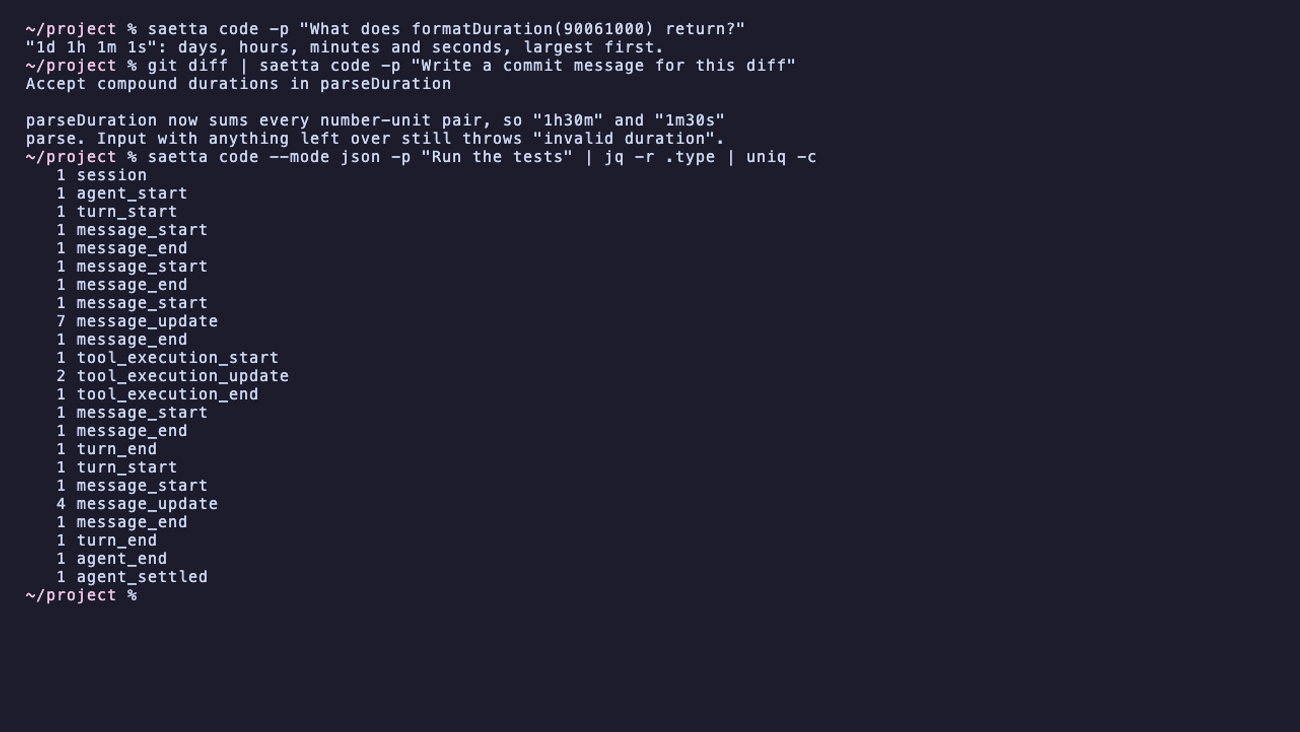
-p (--print) answers the prompt, prints the final text and exits:
saetta code -p "fix the failing test"
saetta code -p --pack 27b-turbo "summarize what src/server.c does"
git log -20 --oneline | saetta code -p "write release notes from these commits"
Piped input is joined to the prompt, and makes the run a print run even without -p. The session is saved as usual (--no-session skips it), so saetta code -c can continue it in the terminal UI.
In a project that is not yet trusted there is no prompt to ask in, so project resources stay off; pass --approve to trust it for the run. See Context and skills.
JSON mode
--mode json prints pi's event stream instead of the text, one JSON object per line: the session header first, then the agent's events as they happen.
saetta code --mode json -p "list the files in src" > events.jsonl| event | when |
|---|---|
session | first line: the session header (format version, id, timestamp, working directory) |
agent_start, agent_end | the run starts and ends |
turn_start, turn_end | each model call with its tool results |
message_start, message_update, message_end | a message is created, streams, is complete |
tool_execution_start, tool_execution_update, tool_execution_end | a tool runs, with partial and final output |
compaction_start, compaction_end | an automatic compaction |
auto_retry_start, auto_retry_end | a failed request is retried |
queue_update | queued steering or follow-up messages changed |
Retries follow retry in settings.json (pi's keys and defaults: enabled true, maxRetries 3, baseDelayMs 2000, maxAgentDelayMs 60000).
RPC mode
--mode rpc is pi's rpc protocol: JSON commands on stdin, one per line, and on stdout a response to each command plus the session's events (the same events as JSON mode). It keeps running until stdin closes, so one process serves many prompts.
saetta code --mode rpc{"id": "1", "type": "prompt", "message": "add a --verbose flag to the CLI"}
{"id": "2", "type": "get_state"}
{"id": "3", "type": "abort"}Each response carries the command's id, "type": "response", the command's name in command, and success with data, or "success": false with an error:
{"id":"2","type":"response","command":"get_state","success":true,"data":{...}}| command | what it does |
|---|---|
prompt | send a message (while streaming, streamingBehavior says whether it steers or follows up) |
steer, follow_up | queue a steering or follow-up message |
abort, clear_queue | stop the turn, drop queued messages |
get_state, get_messages, get_entries, get_tree, get_session_stats | read the session |
get_last_assistant_text, get_fork_messages, get_commands | the last answer, the messages a fork can start from, the commands (MCP and skills) |
new_session, switch_session, fork, clone, set_session_name | manage sessions |
compact, set_auto_compaction | compact now, turn automatic compaction on or off |
set_model, cycle_model, get_available_models | choose the model |
set_thinking_level, cycle_thinking_level, get_available_thinking_levels | choose the thinking level |
set_steering_mode, set_follow_up_mode | one-at-a-time or all |
set_auto_retry, abort_retry | retries of failed requests |
bash, abort_bash | run a shell command into the context, stop it |
export_html | write the session as HTML |
Saetta Code's rpc mode is compared with pi's on 12 recorded scenarios, driven by pi's own rpc client, so a program written against pi's rpc mode drives Saetta Code too. Extension UI requests never occur, since Saetta Code runs no extensions, and image input is not supported.